
The international scientific and analytical, reviewed, printing and electronic journal of Paata Gugushvili Institute of Economics of Ivane Javakhishvili Tbilisi State University

ASSESSMENT OF THE RELATIONSHIP BETWEEN THE LEVEL OF DIGITAL TRANSFORMATION AND EMPLOYMENT INDICATORS (THE CASE OF AZERBAIJAN)
DOI kodi: 10.52340/ekonomisti.2026.03.08
Annotation. The article assesses the relationship between the level of digital transformation and employment indicators in Azerbaijan for 2010-2024. The empirical basis of the study consists of official statistical yearbooks and electronic statistical tables of the State Statistical Committee of the Republic of Azerbaijan. A digital development index is constructed on the basis of internet use, mobile subscriptions, ICT output, and ICT value added. The results show that digital transformation is associated with employment growth, but its main effect is not a simple increase in the number of jobs; rather, it is the restructuring of employment, the growing importance of digital skills, and the expansion of technology-intensive work functions. Correlation and log-log estimation confirm a positive relationship between the digital development index and employment indicators, while the interpretation of the results is limited to association rather than strict causality.
Keywords: digital transformation; employment; labour market; ICT sector; Azerbaijan.
Introduction
Digital transformation is one of the most important driving forces of modern economic development. The spread of the internet, the mass use of mobile communications, the expansion of digital services, artificial intelligence, platform-based employment, remote work and data-driven management systems are reshaping the labour market both quantitatively and qualitatively. Therefore, the question of how digital transformation affects employment is no longer only a technological issue; it has become a complex economic, social and institutional research problem.
Within the concept of the Fourth Industrial Revolution, technological change is emphasized as a process that differs from previous stages in terms of speed, scale and systemic impact. Klaus Schwab argues that this revolution changes not only production technologies, but also the way people live, work and relate to one another [12, p. 7-12]. From the perspective of the labour market, this means that digitalization changes not only the number of jobs, but also the content of work, required skills, employment relations and institutional mechanisms of labour-market regulation.
The relevance of the topic is related to the fact that two extreme approaches are often observed in discussions on digitalization. According to the first approach, automation and artificial intelligence will lead to mass unemployment. According to the second approach, digital technologies will automatically create more productive, flexible and higher-paid jobs. In reality, the impact of digitalization is more complex. It may reduce demand for some routine tasks, but at the same time it creates new areas of employment, strengthens the demand for digital skills and changes the sectoral structure of labour demand.
According to the approach of the International Labour Organization, digital technologies can create new jobs and increase productivity, but they may also deepen existing inequalities and cause job displacement for some groups of workers. For this reason, employment policies that do not take digitalization into account risk missing the opportunity to create decent work and to prevent vulnerable groups from being left behind [9, p. 3]. This position shows that the relationship between digital transformation and employment should be studied not only from a statistical perspective, but also from a policy perspective.
The study of this issue is particularly important for Azerbaijan. In recent years, the country has experienced growth in internet use, expansion of ICT-sector output and value added, the development of digital public services, and a gradual broadening of the digital infrastructure. At the same time, the labour market has undergone changes in terms of the number of employed persons, paid employment, nominal wages and the relative weight of information and communication activities. Therefore, an analysis covering 2010-2024 makes it possible to assess how digital transformation indicators and employment indicators changed over the same period and what type of relationship can be observed between them.
Main part
The impact of digital transformation on the labour market emerges through several channels. The first channel is automation and labour substitution. Tasks that are routine, standardized and algorithmically describable can be performed by digital technologies and automated systems. This may reduce demand for certain traditional job functions, especially repetitive administrative, technical and low-skilled operations.
The second channel is the creative and complementary effect. Digital technologies increase demand for new products and services and create new businesses and professions. Schwab describes this as a capitalization effect, noting that new technologies create new goods and services, thereby generating new professional profiles and employment opportunities [12, p. 37-40]. In this sense, digital transformation can expand employment opportunities when it is combined with innovation, entrepreneurship and human capital development.
The third channel is the change in skill requirements. The digital economy requires employees not only to use computers, but also to work with data, communicate through digital channels, solve problems, adapt to technological change, apply analytical thinking and learn continuously. As a result, the structure of labour demand shifts from purely physical or routine skills toward cognitive, analytical and digital skills.
The fourth channel is the transformation of employment forms. The platform economy, freelance work, remote work and short-term project-based work have expanded as alternatives to traditional permanent employment relations. The IPSE guide defines freelancers as skilled, non-manual self-employed workers who usually work for a fee, provide services to clients and are neither employers nor employees [11, p. 2, 4]. Such forms of work increase flexibility, but also raise issues of income stability, social protection and labour rights.
The fifth channel is the institutional and policy channel. Digitalization affects employment policy through digital employment services, online vacancy maps, electronic registration systems, digital skills programmes and labour-market information systems. The ILO study on digital transformation in employment policies shows that digitalization is increasingly included in national employment policy frameworks and is linked to issues such as inclusion, social dialogue, digital skills and the digital divide [9, p. 17, 21-27].
The data base of the study consists of official statistical yearbooks and electronic statistical tables of the State Statistical Committee of the Republic of Azerbaijan. For digital transformation indicators, the statistical yearbook “Telecommunication and Post in Azerbaijan 2025”, as well as electronic tables on ICT infrastructure and ICT-sector indicators, were used. For labour market indicators, the statistical yearbook “Labour Market 2025” and electronic labour-market tables were used.
The analysis covers 2010-2024. This period is important because it includes the mass diffusion of digital infrastructure, the nominal expansion of the ICT sector, the sharp increase in demand for remote and digital services during the COVID-19 period, and the post-pandemic recovery stage. The period also allows the simultaneous observation of labour force, employment, unemployment, paid employment and wage dynamics.
A digital development index was constructed from four indicators: internet users per 100 persons, mobile telephone subscriptions per 100 persons, ICT output and services at current prices, and ICT-sector value added at current prices. First, each indicator was indexed relative to 2010:
Xit / Xi2010 *100
Then the arithmetic mean of these four sub-indices was calculated. Thus, the index shows the relative development of the digital transformation process compared with the base year 2010.
The log-log model used in the assessment is expressed as follows:
ln(EMPt) = α + βln(DIIt) + ε t
Here denotes the number of employed persons, denotes the digital development index, is interpreted as an elasticity coefficient, and is the error term. In addition, Pearson correlation coefficients were calculated between the digital development index and the employment indicators.
The statistical picture for 2010-2024 shows that digital transformation in Azerbaijan was mainly expressed in the growth of internet use, the expansion of ICT output and value added, the broad diffusion of mobile communications and the gradual increase in employment in the ICT sector. The most dynamic growth is observed in the nominal economic indicators of the ICT sector, while the increase in employment is more moderate.
Table 1.
Dynamics of digital transformation indicators in Azerbaijan
|
Year |
Internet users per 100 persons |
Mobile subscriptions per 100 persons |
ICT output/services, mln manat |
ICT value added, mln manat |
ICT-sector employees, thousand persons |
Digital development index, 2010=100 |
|
2010 |
46.0 |
99.0 |
1,146.2 |
715.8 |
18.3 |
100.0 |
|
2011 |
65.0 |
104.0 |
1,236.4 |
786.7 |
18.5 |
116.0 |
|
2012 |
70.0 |
105.0 |
1,420.2 |
861.8 |
19.0 |
125.6 |
|
2013 |
73.0 |
105.0 |
1,528.0 |
949.0 |
19.3 |
132.7 |
|
2014 |
75.0 |
107.0 |
1,577.5 |
963.3 |
19.9 |
135.8 |
|
2015 |
77.0 |
112.0 |
1,589.2 |
970.7 |
20.1 |
138.7 |
|
2016 |
78.0 |
106.0 |
1,555.9 |
958.7 |
18.0 |
136.6 |
|
2017 |
79.0 |
104.0 |
1,688.0 |
1,038.1 |
18.1 |
142.3 |
|
2018 |
80.0 |
105.0 |
1,826.8 |
1,112.0 |
19.0 |
148.7 |
|
2019 |
81.0 |
109.0 |
2,083.2 |
1,293.3 |
19.3 |
162.2 |
|
2020 |
85.0 |
104.0 |
2,158.2 |
1,600.9 |
20.5 |
175.4 |
|
2021 |
87.0 |
108.0 |
2,249.7 |
1,663.8 |
21.1 |
181.7 |
|
2022 |
88.0 |
110.0 |
2,514.8 |
1,822.2 |
22.5 |
194.1 |
|
2023 |
89.0 |
108.0 |
3,028.1 |
2,021.8 |
23.5 |
212.3 |
|
2024 |
91.0 |
111.0 |
3,437.6 |
2,282.9 |
25.5 |
232.2 |
Source: Compiled and calculated by the author based on the State Statistical Committee of the Republic of Azerbaijan, electronic tables “Main infrastructure indicators of ICT” and “Main indicators of the ICT sector”; State Statistical Committee, Telecommunication and Post in Azerbaijan 2025, pp. 3, 7-8, 60, 70.
Table 1 shows that the number of internet users per 100 persons increased from 46 in 2010 to 91 in 2024. This means that the indicator almost doubled over fourteen years. Mobile subscriptions remained at a high level throughout the period and increased from 99 to 111 per 100 persons. The slower growth of this indicator compared with internet use shows that mobile communications had already reached a relatively high level at the beginning of the period, while internet use had more room for expansion.
ICT output and services increased from 1,146.2 million manat in 2010 to 3,437.6 million manat in 2024, which is almost a threefold increase. ICT value added increased from 715.8 million manat to 2,282.9 million manat, or approximately 3.2 times. These figures show that the digital sector strengthened its nominal economic scale more rapidly than the general spread of basic communication indicators.
The number of employees in the ICT sector increased from 18.3 thousand persons in 2010 to 25.5 thousand persons in 2024. Although the increase of 39.3 percent is important, it is considerably lower than the growth of ICT output and value added. This means that the sector is becoming more productive and more capital- and technology-intensive: the economic volume created per worker is increasing more rapidly than the number of workers.
The digital development index rose from 100 in 2010 to 232.2 in 2024. In other words, according to the selected indicators, the level of digital development more than doubled. The index grew gradually until 2018, accelerated after 2019, and reached its highest level in 2024. This confirms that digital transformation in Azerbaijan has become more visible not only as infrastructure expansion, but also as an economic process:
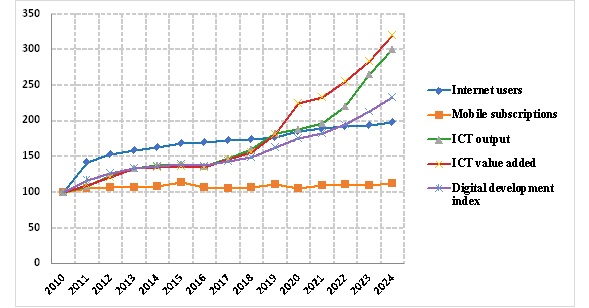
Figure 1. Index dynamics of digital transformation indicators, 2010=100
Source: Author’s calculations based on the electronic statistical tables of the State Statistical Committee on ICT infrastructure and ICT-sector indicators.
Figure 1 illustrates how digital transformation indicators changed in relation to 2010. The index of internet users reached 197.8 in 2024, while the index of ICT output reached 299.9 and the index of ICT value added reached 318.9. The fact that ICT output and value added grew much faster than internet use indicates that the economic depth of digitalization increased more rapidly than simple access indicators. This difference is important for labour-market analysis, because the expansion of the digital economy does not automatically lead to proportional job creation in the ICT sector; it may first of all increase productivity and change the demand for skills.
To assess the impact of digital transformation on the labour market, the study considers general employment, labour force, unemployment, paid employment, average monthly nominal wages and employment in information and communication activities. These indicators make it possible to examine both the quantitative scale and the structural features of the labour market:
Table 2.
Dynamics of labour market and employment indicators in Azerbaijan
|
Year |
Labour force, thousand persons |
Employed population, thousand persons |
Unemployed population, thousand persons |
Unemployment rate, % |
Paid employees, thousand persons |
Average monthly nominal wage, manat |
Information and communication employment, thousand persons |
Information and communication average wage, manat |
|
2010 |
4,587.4 |
4,329.1 |
258.3 |
5.6 |
1,382.9 |
331.5 |
55.8 |
531.3 |
|
2011 |
4,626.1 |
4,375.2 |
250.9 |
5.4 |
1,387.5 |
364.2 |
... |
... |
|
2012 |
4,688.4 |
4,445.3 |
243.1 |
5.2 |
1,480.7 |
398.4 |
... |
... |
|
2013 |
4,757.8 |
4,521.2 |
236.6 |
5.0 |
1,514.0 |
425.1 |
... |
... |
|
2014 |
4,840.7 |
4,602.9 |
237.8 |
4.9 |
1,519.7 |
444.5 |
... |
... |
|
2015 |
4,915.3 |
4,671.6 |
243.7 |
5.0 |
1,502.5 |
466.9 |
60.3 |
747.2 |
|
2016 |
5,012.7 |
4,759.9 |
252.8 |
5.0 |
1,514.3 |
499.8 |
... |
... |
|
2017 |
5,073.8 |
4,822.1 |
251.7 |
5.0 |
1,525.0 |
528.5 |
... |
... |
|
2018 |
5,133.1 |
4,879.3 |
253.8 |
4.9 |
1,551.7 |
544.6 |
... |
... |
|
2019 |
5,037.7 |
4,785.6 |
252.1 |
5.0 |
1,646.6 |
635.1 |
... |
... |
|
2020 |
5,089.9 |
4,721.2 |
368.7 |
7.2 |
1,698.7 |
707.7 |
58.6 |
1,082.6 |
|
2021 |
5,141.6 |
4,831.1 |
310.5 |
6.0 |
1,709.1 |
732.1 |
59.6 |
1,155.4 |
|
2022 |
5,194.4 |
4,901.1 |
293.3 |
5.6 |
1,738.7 |
840.0 |
60.2 |
1,342.4 |
|
2023 |
5,249.7 |
4,963.3 |
286.4 |
5.5 |
1,745.5 |
933.9 |
59.5 |
1,509.9 |
|
2024 |
5,312.1 |
5,029.8 |
282.3 |
5.3 |
1,780.3 |
1,009.4 |
60.2 |
1,672.1 |
Source: State Statistical Committee of the Republic of Azerbaijan, Labour Market 2025, pp. 3, 13, 22-23, 34-35, 61-64; electronic Excel tables on the labour market; author’s calculations.
Note: “...” indicates data not available in the relevant electronic table.
Table 2 shows that the labour force increased from 4,587.4 thousand persons in 2010 to 5,312.1 thousand persons in 2024, while the number of employed persons increased from 4,329.1 thousand to 5,029.8 thousand persons. Thus, total employment increased by 16.2 percent during the period. This increase shows that the expansion of digitalization did not coincide with a decline in total employment; rather, employment grew moderately in parallel with digital development.
The number of unemployed persons was 258.3 thousand in 2010 and 243.7 thousand in 2015, while it rose to 368.7 thousand in 2020. The increase in the unemployment rate to 7.2 percent in 2020 was primarily related to the labour-market shock created by the COVID-19 pandemic. In the following years, unemployment gradually declined and reached 5.3 percent in 2024. This dynamic shows that short-term shocks can temporarily dominate the relationship between digitalization and employment.
The number of paid employees increased from 1,382.9 thousand in 2010 to 1,780.3 thousand in 2024, an increase of approximately 28.7 percent. This growth is higher than the growth of total employment and indicates the strengthening of formal and paid employment. The expansion of paid employment is important because digital labour-market policies, skills programmes and social protection mechanisms are usually easier to implement through formal employment channels.
Average monthly nominal wages increased from 331.5 manat in 2010 to 1,009.4 manat in 2024. In the information and communication sector, the average wage reached 1,672.1 manat in 2024. This level is significantly higher than the national average wage and shows that technology-intensive activities are associated with higher labour remuneration. However, this also implies that digital transformation may increase wage differentiation if digital skills are unevenly distributed.
Employment in information and communication activities was 55.8 thousand persons in 2010 and 60.2 thousand persons in 2024. The increase is limited. Two points should be considered. First, digital employment is not confined to the information and communication sector; digital work functions are also found in finance, education, health, logistics, trade, public administration and industry. Second, the growth of value added in the information and communication sector outpaced employment growth, indicating a rise in labour productivity:
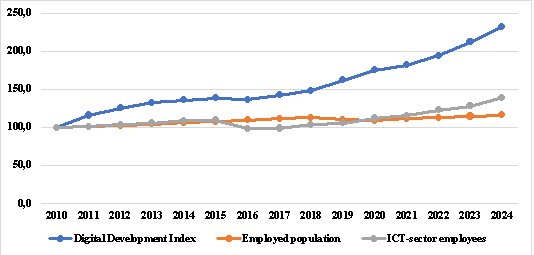
Figure 2. Digital development index and employment indicators, 2010=100
Source: Author’s calculations based on electronic statistical tables of the State Statistical Committee on ICT and the labour market.
Figure 2 compares the dynamics of the digital development index, employed population and ICT-sector employees relative to 2010. In 2024, the digital development index rose to 232.2, while the employed population index reached 116.2 and the ICT-sector employment index reached 139.3. This difference demonstrates that the growth rate of digital transformation was much higher than the growth rate of total employment.
Correlation calculations show a positive and strong relationship between the digital development index and the number of employed persons: r = 0.867. The relationship between the digital development index and ICT-sector employees is even stronger: r = 0.914. These results support the idea that digital transformation is positively associated with employment dynamics, especially with employment in the digital sector.
According to the log-log model, a 1 percent increase in the digital development index is associated with an approximately 0.18 percent increase in the number of employed persons. The explanatory power of the model is R2 = 0.794. For ICT-sector employment, the elasticity is higher, approximately 0.39 percent, which means that the digital sector is more directly sensitive to digital development than the overall labour market.
At the same time, the obtained results should not be interpreted as strict causal evidence. First, digital development and employment are simultaneously influenced by general economic growth, investment, demographic changes, education levels, sectoral restructuring and public policy. Second, the indicators used in the digital development index include nominal variables, which may reflect both real expansion and price effects. Third, the period includes external shocks such as the COVID-19 pandemic. Therefore, the results should be interpreted as evidence of association and structural linkage.
The analysis shows that the effect of digitalization on the labour market in Azerbaijan is most clearly expressed in three directions. The first direction is the growing economic weight of the digital sector. The increase in ICT output and value added strengthens the role of digital activities in the economy. The second direction is the strengthening of high-wage, skill-intensive employment. The higher wage level in information and communication indicates the economic value of digital skills. The third direction is the spread of digital work functions across non-ICT sectors.
Digital transformation does not completely eliminate demand for low-skilled labour, but it changes the nature of that labour. Platform-based delivery services, warehouse and logistics systems, electronic commerce and digital customer services may create job opportunities for workers with different skill levels. However, even these jobs increasingly require basic digital literacy, mobile application use, electronic payment skills and customer communication through digital channels. Thus, the boundary between low-skilled and digitally enabled work is becoming less clear.
The main challenge created by digital transformation in the labour market is the mismatch of digital skills. A high level of internet use alone is not sufficient for participation in the digital labour market. The key issue is whether the workforce can use digital technologies productively in specific job functions. Therefore, the development of digital skills should be considered as an integral part of employment policy, not as a separate educational measure.
The indicators for Azerbaijan for 2010-2024 demonstrate that digitalization does not have a direct and linear effect on the labour market. While the digital development index more than doubled, total employment increased moderately. This means that the main effect of digitalization is not the mechanical creation of jobs, but the structural transformation of employment. Digitalization changes the content of jobs, the skills required for work, wage differentiation and the sectoral distribution of labour demand.
The analysis also shows that the increase in the number of ICT-sector employees lags behind the growth of output and value added. This is a sign that the sector is capital- and technology-intensive. However, this should not be interpreted negatively. In technologically advanced sectors, employment growth may be moderate, while productivity, wages and innovation capacity may increase. Therefore, the assessment of digital transformation should include not only the number of jobs, but also the quality of jobs, productivity and skill intensity.
In this context, the main direction of employment policy should not be limited to increasing the number of jobs in the ICT sector. The broader objective should be to build a digitally skilled workforce across all sectors. Manufacturing, agriculture, services, finance, logistics, public administration and education all require workers capable of using digital tools. This means that digital employment policy should be cross-sectoral rather than sector-specific.
The second priority is reducing regional digital divides. Although the general level of internet use is high, participation in the digital labour market depends on the quality of connectivity, broadband access, digital devices, training opportunities and the digital capacity of local enterprises. Therefore, digital infrastructure and digital literacy programmes in the regions are necessary for inclusive employment growth.
The third priority is the regulation of platform and freelance employment. Digital platforms expand employment opportunities, but they also raise issues related to social protection, income stability, tax accounting, labour rights and professional development. The ILO guide on the gig economy notes that gig work may provide opportunities for income, experience and networking, but it may also involve unstable income, limited labour and social protection, stress and long working hours [10, p. 5, 26]. These risks should be considered in policy design.
The fourth priority is the development of digital employment services. Matching jobseekers and employers through electronic platforms, creating vacancy and skills maps, and forecasting labour demand based on data can increase the efficiency of employment policy. The digitalization of employment services can also make labour-market information more accessible for youth, women, regional workers and vulnerable groups.
The fifth priority is the expansion of statistical monitoring. Measuring the impact of digital transformation on the labour market only through the number of ICT-sector employees is insufficient. It is necessary to measure digital work functions, digital skills, remote work, platform employment, freelance activity, digital entrepreneurship and sectoral skill gaps more systematically.
The assessment of the relationship between digital transformation and employment should not be limited to the description of statistical dynamics. On the basis of the results obtained, practical mechanisms are needed to adapt the labour market to the digital economy. These mechanisms should combine education policy, employment policy, social protection, enterprise development and regional development.
For this reason, training programmes in employment policy should not be general and formal. They should be linked to specific work functions by sector. For example, agriculture needs digital mapping and monitoring skills; industry needs automation and equipment-control skills; services need digital marketing, customer management and electronic payment skills; public administration needs data management and electronic service skills. A function-based approach makes digital skills more applicable and measurable.
The second mechanism is to establish an operational link between the education system and the labour market. Because digital occupations change rapidly, traditional curricula may be updated too slowly. Therefore, universities, vocational education institutions and employers should jointly identify emerging digital occupations and regularly renew curricula. Short-cycle certification programmes can also play an important role in the rapid reskilling of workers.
The third mechanism is data-driven management of digital employment services. The skills of jobseekers, the requirements of employers, the geography of vacancies and sectoral wage expectations should be integrated into a single analytical system. Such a system can help identify which digital skills are most in demand and which groups need targeted support.
The fourth mechanism is support for digital entrepreneurship and freelance activity. The digital economy enables individuals to provide services regardless of geographical location, receive online orders, work with international platforms and develop micro-businesses. This is especially important for young people, women and regional workers. However, such opportunities require digital literacy, language skills, payment systems, tax awareness and professional reputation-building.
The fifth mechanism is the adaptation of social protection to digital forms of work. In platform-based and project-based work, income flows may be unstable, working time may be irregular and the worker’s status may not fit the classical employee model. Therefore, social protection mechanisms should be flexible enough to cover workers in non-standard forms of employment without reducing the innovative potential of the digital economy.
The sixth mechanism is improving the digital capacity of small and medium-sized enterprises. Large enterprises are usually able to invest in digital technologies more quickly, whereas small enterprises may face financial, skill and management constraints. Digital transformation programmes for SMEs can increase productivity and create new demand for workers with digital skills.
The seventh mechanism is the conceptual broadening of statistical monitoring. At present, several digital transformation indicators are measured mainly at the level of ICT sector and infrastructure. However, from a labour-market perspective, it is equally important to measure the digital content of jobs in non-ICT sectors. Future surveys should include questions on digital skills, remote work, platform work, online income generation and the use of digital tools in the workplace.
Since the study is based on official statistical indicators, its results rely on a reliable data base. Nevertheless, several methodological limitations exist. First, the analysis covers 2010-2024 and uses annual observations. This number of observations is limited for complex econometric modelling. Therefore, the empirical estimates are used mainly to identify the direction and strength of association rather than to construct a comprehensive causal model.
The second limitation is related to measurement. ICT output and ICT value added used in the digital development index are given at current prices. This means that nominal growth may include both real expansion and price effects. In future research, the use of constant-price indicators or deflated series would allow a more accurate assessment of real digital-sector growth.
The third limitation is that digital employment cannot be measured only by ICT-sector employment. Digitally skilled employees work in banking, education, health care, industry, logistics, trade, public administration and the media. Therefore, sectoral employment statistics may underestimate the real scale of digital work. Future research should focus on occupations and work functions rather than only on economic activity sectors.
The fourth limitation is the scarcity of statistical information on platform employment and freelance activity. A part of the digital labour market may not be fully reflected in classical paid-employment indicators. This issue is particularly relevant for remote services, gig work and online self-employment. For this reason, special surveys are needed to measure digital work more accurately.
One of the most appropriate directions for future research is to build a panel model across regions and economic activities. Such a model could assess the relationship between digital infrastructure, education level, sectoral employment, wages and productivity more comprehensively. In addition, a microdata-based analysis of individual workers would make it possible to assess how digital skills influence employment probability and wages.
The impact of digital transformation on employment is not the same across economic activities. In the information and communication sector, the impact is direct: software development, telecommunications, data processing, cybersecurity and the provision of digital services create new specialized jobs. At the same time, the sector requires higher qualifications and continuous updating of skills.
In industry and manufacturing, digitalization changes work functions through automation, sensor technologies, production monitoring, quality control and supply-chain management. In this direction, demand for traditional physical labour may decline, while demand for technical operators, system supervisors, data analysts and maintenance specialists may increase. Therefore, industrial employment policy should combine technological modernization with worker reskilling.
In the service sector, the employment effect of digitalization is more flexible. E-commerce, digital marketing, online customer services, tourism platforms, electronic payments and delivery systems create new job opportunities and change the content of traditional service occupations. In these areas, even medium-skilled workers need digital communication and platform-use skills.
In public administration and social services, digital transformation can increase labour productivity through e-government, electronic applications, databases and automation of service processes. The main risk in this direction is the digital exclusion of citizens and workers who have limited access to digital tools. Therefore, the digitalization of public services should be accompanied by digital inclusion policies.
For agriculture, logistics and small businesses operating in the regions, digitalization is important in terms of access to new markets, product traceability, online orders, efficient resource use and cost reduction. However, the employment effect of digital transformation in these areas depends on internet quality, access to equipment, digital training and the managerial capacity of enterprises.
Conclusion
The analysis shows that digital transformation indicators in Azerbaijan increased significantly during 2010-2024. The number of internet users per 100 persons rose from 46 to 91, ICT output and services increased almost threefold, and ICT-sector value added increased 3.2 times. The digital development index rose from 100 in 2010 to 232.2 in 2024, which indicates that the level of digital transformation more than doubled during the period.
During the same period, the number of employed persons increased from 4,329.1 thousand to 5,029.8 thousand persons, or by 16.2 percent. The number of paid employees increased by 28.7 percent. These indicators show a positive direction of relationship between digitalization and employment, but they also demonstrate that the effect of digital development on total employment is not proportional. Digitalization grows faster than employment and mainly changes the structure and quality of labour demand.
According to the correlation and log-log assessment, the relationship between the digital development index and employed population is positive at r = 0.867, while the relationship between the digital development index and ICT-sector employees is r = 0.914. The log-log model shows that a 1 percent increase in the digital development index is associated with an approximately 0.18 percent increase in total employment. These findings confirm a positive association, but they should not be interpreted as strict causal effects.
The main scientific conclusion of the article is that digital transformation in Azerbaijan changes the labour market not simply through the logic of job growth or job decline, but through the logic of structural transformation. Digitalization weakens some routine job functions, creates new digital work areas and skills, increases the importance of technology-intensive sectors and raises the need for continuous human-capital development.
From a practical perspective, the development of digital skills, the adaptation of vocational and higher education to the digital labour market, the strengthening of digital infrastructure and digital literacy in the regions, the social protection of platform workers, the expansion of digital employment services and the statistical measurement of digital labour-market indicators should be considered key policy priorities.
References
1. State Statistical Committee of the Republic of Azerbaijan. Telecommunication and Post in Azerbaijan 2025. Statistical yearbook. Baku: SSC, 2025, pp. 3, 7-8, 60, 70.
2. State Statistical Committee of the Republic of Azerbaijan. Labour Market 2025. Statistical yearbook. Baku: SSC, 2025, pp. 3, 13, 22-23, 34-35, 61-64.
3. State Statistical Committee of the Republic of Azerbaijan. Main infrastructure indicators of ICT. Electronic statistical table, table 1.1, 2010-2024.
4. State Statistical Committee of the Republic of Azerbaijan. Main indicators of the ICT sector. Electronic statistical table, table 1.2, 2010-2024.
5. State Statistical Committee of the Republic of Azerbaijan. Main indicators of ICT use in enterprises. Electronic statistical table, table 3.1, 2010-2021.
6. State Statistical Committee of the Republic of Azerbaijan. Number of employed persons by economic activities. Electronic statistical table, table 2.1, 2010-2024.
7. State Statistical Committee of the Republic of Azerbaijan. Number of paid employees by economic activities. Electronic statistical table, table 2.8, 2010-2024.
8. State Statistical Committee of the Republic of Azerbaijan. Average monthly nominal wage by economic activities. Electronic statistical table, table 4.2, 2010-2024.
9. Chacaltana, J., Prieto Berhouet, M., Perrot, B., & Lindgren, M. Digital Transformation in Employment Policies. Geneva: International Labour Organization, 2024, pp. 3, 17, 21-27.
10. International Labour Organization. Exploring the Gig Economy: Challenges and Opportunities. A self-guided resource. Geneva: ILO, 2025, pp. 5, 26, 28.
11. IPSE. Introduction to Freelancing. London: Association of Independent Professionals and the Self-Employed, pp. 2, 4.
12. Schwab, K. The Fourth Industrial Revolution. Geneva: World Economic Forum, 2016, pp. 7-12, 37-40.