
The international scientific and analytical, reviewed, printing and electronic journal of Paata Gugushvili Institute of Economics of Ivane Javakhishvili Tbilisi State University

Modern Challenges of Digitalization in the Georgian Hotel Industry
Expanded Summary
This paper discusses the role of digital technologies in global and local tourism and the hospitality sector, analyzing the primary challenges within the digitalization process of Georgia\\\\'s hotel sector. It outlines the current market state and digitalization trends of the Georgian hotel industry, covers the theoretical foundations and global trends of digitalization in hospitality, and evaluates the structure of the Georgian hotel market alongside existing digital divides.
Keywords: Digitalization, hotel industry, challenges, markets, technologies
Introduction
In the contemporary global economy, the rapid development of digital technologies has fundamentally transformed the service sector, particularly the hospitality and tourism industry (Buhalis & Law, 2008). Today, digitalization is no longer merely a competitive advantage—it has become a prerequisite for survival and sustainable development within the industry (UNWTO, 2021).
For Georgia, where tourism is a leading economic sector, introducing digital tools in hotels is directly linked to enhancing service quality and maintaining competitiveness in the international market (Georgian National Tourism Administration [GNTA], 2023). Despite technological progress, the Georgian hotel industry faces numerous systemic, financial, and personnel-related barriers on the path to digital transformation (Law et al., 2019).
Digitalization in the hotel industry encompasses a broad spectrum of technological solutions divided into two main groups: Front-Office (guest-facing) and Back-Office (internal operational) technologies (Ivanov & Webster, 2019). The primary components of digitalization include:
- Property Management System (PMS): A centralized digital hotel management system integrating reservations, housekeeping schedules, billing, and guest data (Law et al., 2019).
- Online Travel Agencies (OTA) & Channel Managers: Platforms (Booking.com, Airbnb, Expedia) and their synchronizers that ensure global room distribution and prevent double-booking risks.
- Revenue Management Systems (RMS): Dynamic pricing algorithms that automatically determine optimal room rates based on demand, seasonality, and competitor pricing (Kimes, 2011).
Global trends indicate that transitioning from traditional, paper-based or mechanically managed processes to Cloud-based systems is a prerequisite for ensuring operational efficiency (Buhalis & Law, 2008).
Structure of the Georgian Hotel Market and the Digital Divide. The Georgian hotel market is sharply asymmetric, exhibiting a clear Digital Divide in terms of digital technology adoption (National Statistics Office of Georgia [Geostat], 2023):
- International Branded Hotels (Marriott, Hilton, Radisson, etc.): Possess high digital readiness. They fully utilize global PMS/RMS systems, proprietary loyalty apps, and automated services.
- Local Mid-scale and Boutique Hotels: Characterized by a moderate level of digitalization. They actively use Cloud-PMS and Channel Managers, though they rarely resort to deep data analytics.
- Small and Family-run Hotels (Guesthouses) in Regions: Exhibit low or basic digital readiness. They rely solely on Booking.com and Airbnb, while internal management is frequently manual (Geostat, 2023).
Additionally, a geographical disparity exists: accommodation facilities in Tbilisi and Batumi are significantly more digitalized than hotels located in high-mountainous and remote regions (GNTA, 2023).
The full-scale implementation of digital technologies in the Georgian hotel industry is hindered by several fundamental barriers:
Data 1. Challenges of digitalization in Georgia
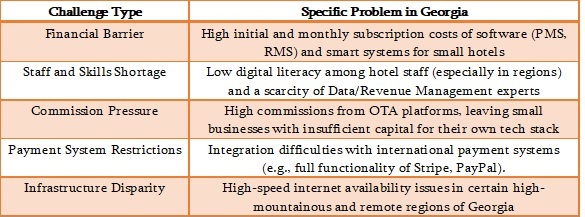
Financial Barrier: The initial deployment and monthly subscriptions for modern software (PMS, RMS, CRM) and smart systems (IoT) are quite costly for small and medium-sized businesses (UNWTO, 2021). Small family hotels frequently lack free working capital to invest in licensed programs or digital hardware.
- Commission Pressure: Most Georgian hotels are overly dependent on online travel agencies, particularly Booking.com (GNTA, 2023). Due to the lack of proper proprietary websites and Direct Booking Engines, hotels are forced to pay commissions ranging from 15% to 25% per booking, which heavily pressures net profits.
- Human Resources and Qualifications: The efficiency of digital tools directly correlates with staff qualifications (Ivanov & Webster, 2019). Regional family-run hotels suffer from low digital literacy among owners and staff, and the market faces an acute shortage of specialized Revenue Management and Data Analytics experts.
Conclusions and Recommendations
- Uneven Progress: The digitalization process in the Georgian hotel industry is uneven, causing a digital divide between large international brands and small family hotels.
- Key Inhibitors: The primary hindering factors include limited financial resources, OTA commission pressures, low personnel digital literacy, and payment infrastructure constraints.
- Strategic Recommendations: Addressing these challenges requires a comprehensive approach involving hotel management, the state, and industry associations:
- For Hotels: Transition to affordable, budget-friendly Cloud-PMS systems; develop simple Direct Booking tools and social media channels to reduce OTA commissions; periodically train employees on digital tools.
- For Government and Associations: Organize regional educational programs and workshops to boost digital literacy; create small grant or co-financing mechanisms to support regional hotel digitalization; actively work on full integration of international fintech platforms with the Georgian banking sector.
References
- Buhalis, D., & Law, R. (2008). Progress in information technology and tourism management: 20 years on and 10 years after the millennium—The state of eTourism research. Tourism Management, 29(4), 609–623. https://doi.org/10.1016/j.tourman.2008.01.005
- Georgian National Tourism Administration. (2023). Georgian tourism in figures: Annual report. Ministry of Economy and Sustainable Development of Georgia.
- Ivanov, S., & Webster, C. (2019). Robots, artificial intelligence, and service automation in travel, tourism and hospitality. Emerald Publishing Limited.
- Kimes, S. E. (2011). The future of hotel revenue management. Cornell Hospitality Report, 11(14), 6–15.
- Law, R., Leung, R., & Chan, I. C. C. (2019). Progression and development of information and communication technology research in hospitality portal: A 30-year review. International Journal of Contemporary Hospitality Management, 31(1), 2–22. https://doi.org/10.1108/IJCHM-07-2017-0426
- National Statistics Office of Georgia. (2023). Hotels and hotel-type enterprises in Georgia 2022. https://www.geostat.ge
- UNWTO. (2021). Digital transformation in tourism: Small and medium-sized enterprises perspective. World Tourism Organization. https://doi.org/10.18111/9789284422203
https://doi.org/10.18111/9789284422203